
Stationary vs. Mobile Ball Machine: How the Partner V2 Does Both
Nearly every ball machine on the market picks one mode. The Partner V2 gives you both — fixed-position consistency for fundamentals and AI-powered court movement for match-realistic training.
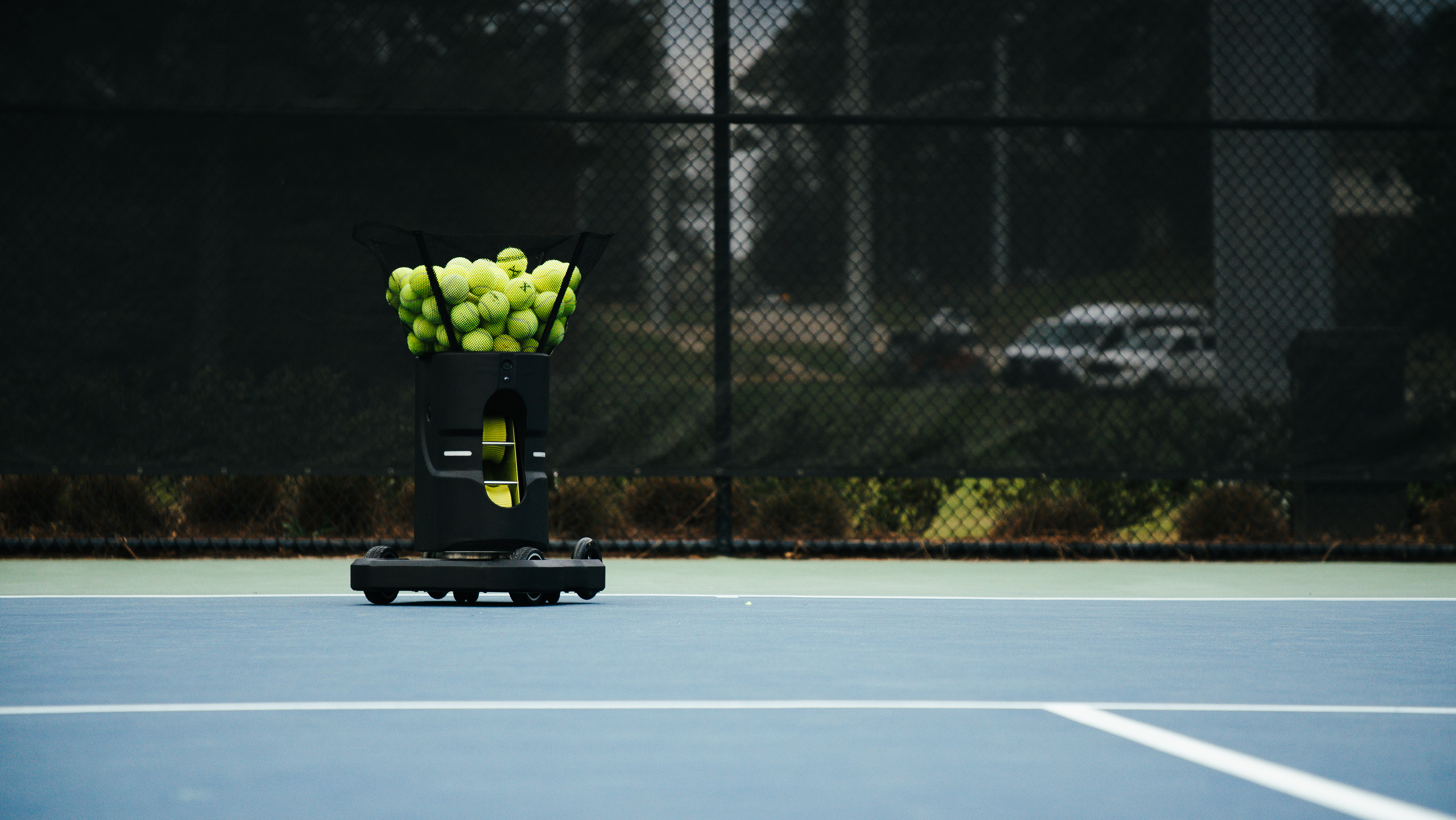
If you've ever shopped for a tennis ball machine, you've probably noticed that nearly every option on the market does the same thing: it sits in one spot and fires balls at you. That's a stationary ball machine, and it's been the standard for decades. But there's a growing category of machines that actually move during your session — and the distinction matters more than most players realize.
The Tennibot Partner V2 is one of the few ball machines that gives you both. It has a stationary mode for consistent, repeatable drills from a fixed position, and a mobile mode where it rolls along the baseline and changes shot angles in real time. That dual capability is worth understanding, whether you're a beginner looking for a reliable practice tool or an advanced player who wants something closer to a live hitting partner.
What Is a Stationary Ball Machine?
A stationary ball machine is a ball machine that stays in one fixed position on the court during your entire practice session. You place it on or behind the baseline (or at the net for volleys), set your desired speed, spin, and feed rate, and it delivers balls from that single location. Most ball machines on the market today — from entry-level models to premium machines costing several thousand dollars — are stationary ball machines.
Stationary mode is ideal for a few specific training goals. If you're working on your forehand crosscourt, you want the ball coming from the same spot with the same trajectory so you can groove your swing path. If you're a beginner building basic stroke mechanics, a fixed-position ball machine provides the repetition and predictability you need to develop muscle memory without the added complexity of adjusting to changing angles.
Stationary ball machines are best for: Beginners learning basic stroke mechanics, repetitive drills focused on a single shot (forehand, backhand, serve return), consistency training where you want identical ball placement, coaches running structured feeding drills from a set position, and warm-ups and cool-downs with predictable ball delivery.
A fixed position is not the same as a fixed shot. A good stationary machine still places balls all around the court, deep, short, wide and down the middle, at whatever spin and pace you set, so you can be moving constantly while the machine holds its spot. What it does not reproduce is the ball arriving from a different angle each time, the way it does when an opponent shifts position between shots. That is the honest tradeoff, and for a lot of players it is the right one to make.
Tennibot makes a machine for exactly this way of training. The Partner Lite is our stationary machine: 25 lbs, $1,495, running the same AI custom drills, the same app and the same spin and placement control as the flagship. It stays where you set it down.
What Is a Mobile Ball Machine?
A mobile ball machine is a ball machine that physically moves during your practice session, changing its position on the court and altering the angle of incoming shots. Instead of feeding from a single fixed point, a mobile ball machine rolls along the baseline — or across the court — to simulate the way a live opponent shifts position between shots.
This is a much newer category. Until recently, the technology to make a ball machine move intelligently (not just randomly) didn't exist in a consumer product. The Tennibot Partner V2 is one of the first ball machines to offer true mobile functionality, using 4K cameras and 3D object tracking to follow your movement and adjust its own position in real time.
Mobile ball machines are best for: Intermediate and advanced players training match-realistic scenarios, footwork and court coverage drills where shot angles change constantly, players who want to practice reading the ball off different court positions, simulating a real practice partner when you don't have one available, and breaking out of the "groove" that stationary-only practice can create.
How the Partner V2 Does Both
The Partner V2 is designed to function as both a stationary ball machine and a mobile ball machine, depending on how you set it up. This isn't a compromise — both modes are fully featured.
Stationary Mode (Fixed Position)
When you use the Partner V2 in stationary mode, it operates like a traditional ball machine. You place it on the court, pick your drill, and it feeds from that fixed position. You get full control over ball speed (10–70 MPH), spin (up to 3,600 RPM of topspin or backspin), elevation (10–40 degrees), and feed rate (every 2–15 seconds). With a 140-ball hopper for tennis (250 for pickleball), you can run long, uninterrupted sessions.
This is the beginner-friendly mode. If you're new to the sport, or if you're working on a specific stroke and want maximum consistency, stationary mode gives you the reliable repetition that builds fundamentals. Coaches also use stationary mode when running structured drills where they want full control over ball placement.
You program everything through the Tennibot app (iOS or Android) or directly from an Apple Watch. Hundreds of pre-loaded drills are available, plus you can build and save your own custom sequences.
Mobile Mode (Moving Along the Baseline)
When you switch to mobile mode, the Partner V2 becomes something fundamentally different from a traditional ball machine. It rolls along the baseline, continuously changing its position and the angle of its shots. Its 4K cameras track your position on the court in real time, and its on-device AI (8 TOPS of neural network processing power) adapts every shot based on where you are and how you're moving.
This is what makes the Partner V2 the first ball machine that moves and responds to you in real time. It doesn't just fire balls from shifting positions randomly — it reads the court and makes intelligent decisions about shot placement, pace, and direction. The experience is closer to rallying with a live practice partner than anything a stationary ball machine can offer.
Why Having Both Modes Matters
Having both stationary and mobile modes in a single machine means you don't have to choose between building fundamentals and training for match play. A typical practice session might look like this:
No other ball machine on the market offers this kind of flexibility in a single unit that weighs just 35 pounds and runs for 4–5 hours on a single charge. If court movement is not what you are training, the Partner Lite gives you the same drills and the same app in a lighter, stationary package.
Works for Tennis, Pickleball, and Padel
The Partner V2 isn't limited to tennis. The same stationary and mobile modes are available for pickleball and padel, with sport-specific ball capacities and speed settings (up to 65 MPH for pickleball). Whether you're drilling third-shot drops from a fixed position or simulating a moving opponent on a padel court, the Partner V2 adapts to your sport.
Pair It with the Rover for Fully Autonomous Training
One of the biggest drawbacks of any ball machine — stationary or mobile — is that someone has to pick up the balls. The Tennibot Rover solves that. It's an autonomous ball collector that uses AI vision to find and gather balls on its own, holding up to 90 tennis balls per run.
When you pair the Partner V2 with the Rover, you get a fully autonomous training loop: the Partner V2 feeds balls, you hit them, and the Rover collects them — no manual pickup, no wasted time. The Partner V2 and Rover bundle is available for $3,995 with a 60-day risk-free trial, 3-year warranty, and free shipping in the USA.
If you're deciding between a stationary ball machine and a mobile ball machine, Tennibot builds both, and the honest answer depends on how you train. Choose the Partner Lite at $1,495 if you want the lightest machine to carry and you drill from a fixed feed position. Choose the Partner V2 at $2,275 if you want one machine that does both: fixed position for structured repetition, mobile mode for real-time, AI-adaptive training that simulates a live practice partner. Both run the same AI custom drills, the same app, and the same spin and placement control, so neither is the compromise version of the other.
Frequently Asked Questions
Is the Tennibot Partner V2 a stationary ball machine?
The Tennibot Partner V2 works as both a stationary ball machine and a mobile ball machine. In stationary mode, it stays in a fixed position on the court and delivers consistent feeds — ideal for beginners and repetitive drills. In mobile mode, it rolls along the baseline and changes shot angles in real time using 4K cameras and AI tracking.
Does the Tennibot Partner V2 have a stationary mode?
Yes. The Partner V2 has a full stationary mode where it operates from a fixed position on the court, just like a traditional ball machine. You get full control over ball speed (10–70 MPH), spin (up to 3,600 RPM), elevation (10–40 degrees), and feed rate (every 2–15 seconds). Stationary mode is the beginner-friendly mode, ideal for building stroke mechanics and running structured drills.
Does Tennibot make a stationary-only ball machine?
Yes. The Partner Lite is a stationary AI ball machine at $1,495. It weighs 25 lbs and runs the same AI custom drills, the same app and the same spin and placement control as the Partner V2. It holds its position instead of moving around the court, and it still places balls all over the court while it does.
What is a mobile ball machine?
A mobile ball machine is a ball machine that physically moves during your practice session, changing its position on the court and altering the angle of incoming shots. The Tennibot Partner V2 is one of the first ball machines to offer true mobile functionality, using 4K cameras and 3D object tracking to follow your movement and adjust its position in real time.
What sports does the Tennibot Partner V2 support?
The Tennibot Partner V2 supports tennis, pickleball, and padel. Both stationary and mobile modes are available for all three sports, with sport-specific ball capacities (140 tennis balls, 250 pickleballs) and speed settings (up to 70 MPH for tennis, 65 MPH for pickleball).
How much does the Tennibot Partner V2 cost?
The Tennibot Partner V2 is priced at $2,275. The Partner V2 and Rover bundle (which adds an autonomous ball collector for fully autonomous training) is $3,995. Both come with a 60-day risk-free trial, 3-year warranty, and free shipping in the USA.
Can I use the Tennibot Partner V2 as a beginner?
Yes. The Partner V2's stationary mode is specifically designed to be beginner-friendly. It delivers balls from a fixed position at adjustable speeds starting from 10 MPH, giving new players the predictable repetition they need to build basic stroke mechanics. As you improve, you can switch to mobile mode for more advanced, match-realistic training.