
How to Choose a Pickleball Machine (2026 Buyer's Guide)
Six factors decide whether a pickleball machine becomes your best training partner or a $2,000 garage ornament. Here's how every major machine actually stacks up, ours and our competitors' alike.
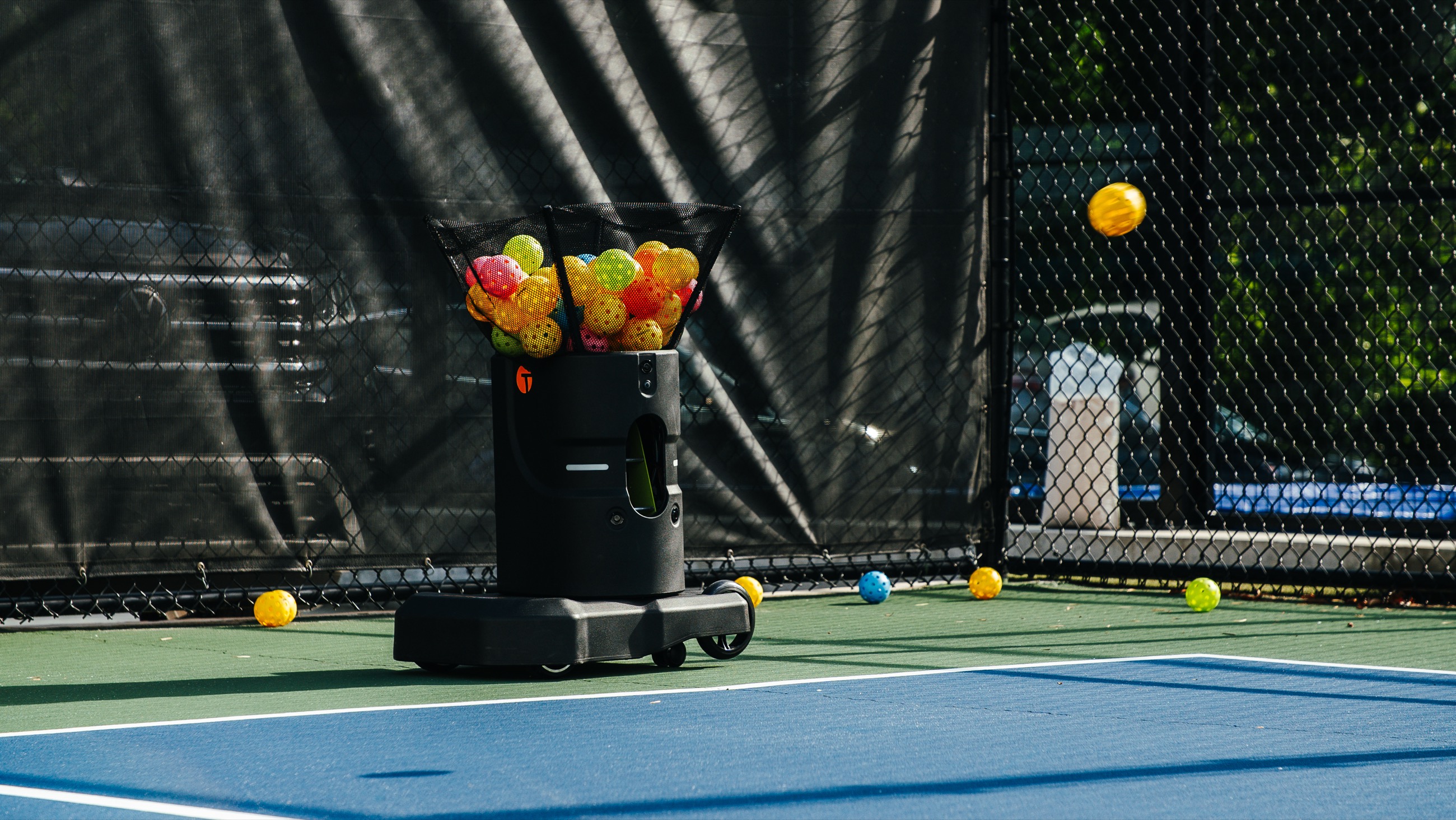
A pickleball machine is the fastest way to get more reps than any practice partner can feed you, but the wrong machine becomes a $2,000 garage ornament. The right choice comes down to six factors: ball capacity, throwing performance (speed and spin), oscillation versus true court movement, control style, battery life, and the warranty behind it.
This guide walks through each factor with real specs from every major machine on the market in 2026, including ours and our competitors', so you can decide what actually matters for your game.
What Does a Pickleball Machine Do?
A pickleball machine (also called a pickleball ball machine or pickleball practice machine) automatically feeds balls at adjustable speeds, spins, trajectories, and intervals so you can drill without a partner. Entry-level machines toss a predictable ball to one spot. Advanced machines randomize placement, simulate dinks and drives, and, at the top end, use AI cameras to track your position and move around the court like a real opponent.
The 6 Factors That Matter
1. Ball capacity: how long you rally before you pick up balls
Capacity determines how long you hit before practice turns into ball collection. Most machines hold 85–150 pickleballs:
| Machine | Ball capacity |
|---|---|
| Titan ONE | 85 (240 with extension) |
| Erne | 150 |
| Lobster Pickle Champion | 135 |
| Pickleball Tutor Plus | 110 |
| Tennibot Partner | 250 |
At a typical feed rate of one ball every 3–4 seconds, an 85-ball hopper empties in under 5 minutes. A 250-ball hopper gives you 12–15 minutes of continuous hitting per cycle. If you hate chasing balls (it's why we started this company), capacity is the spec to check first.
2. Speed and spin: can it push you?
For pickleball, look for a top speed of at least 60 MPH (enough to simulate hard drives and speed-ups) and adjustable topspin/backspin for realistic dinks and drops. Most quality machines deliver 60–70 MPH. What separates them is consistency: machines with braking motors hold speed and spin steady shot after shot, while cheaper friction wheels drift as they warm up.
If you're a 3.0 player today, buy for the 4.0 player you're becoming. A machine you outgrow in a season is the most expensive kind.
3. Oscillation vs. true movement: where the ball comes FROM
Almost every machine oscillates: it sweeps shots left and right across the court. That trains your lateral movement, but every ball still originates from the same spot, which is nothing like playing a human.
A small number of machines actually move across the court between shots. When the machine itself relocates, the ball comes at you from different angles and depths, the way it does from a real opponent. As of 2026, the Tennibot Partner is the only pickleball machine that drives itself around the court; everything else (Titan, Erne, Lobster, Pickleball Tutor) is stationary with internal oscillation.
If you mostly drill mechanics, oscillation is fine. If you want match simulation, movement is the feature that changes practice.
4. Control style: knobs, remotes, or an app
There are three control philosophies, and the right one depends on you:
Knobs and dials (Pickleball Tutor Plus, Sports Tutor Multi-Twist): nothing to pair, nothing to update. Coaches who run 6–8 hours of lessons a day often prefer this: set it and feed. The tradeoff is no drill memory and no randomization beyond basic oscillation. Remote control (Lobster Pickle Champion): mid-ground. Change settings from across the court, but limited drill programming; check phone compatibility, since some remotes are iOS-only. Full app control (Titan ONE, Erne, Tennibot Partner): build, save, and share custom drills from your phone; adjust every parameter courtside; get updates that add features over time.
The newest machines layer AI on top. The Tennibot Partner generates custom drills from a description of what you want to work on, and its 4K cameras track ball flight and player position in 3D.
5. Battery life and charge time: the spec everyone forgets
A long session is 2–3 hours, so a 2–3 hour battery (Titan ONE, Spinshot) means the machine dies when you do. And if it takes overnight to recharge, your machine has a strict one-session-per-day limit. Look for 4+ hours of battery and pay close attention to charge time: machines range from a 90-minute charge (Tennibot Partner) to 4–6 hours (Erne) to 10–16 hours (Spinshot).
Weight matters too if you're hauling the machine from car to court: pickleball machines range from 11 lbs (the lob-only Multi-Twist) through 27–35 lbs (Pickleball Tutor Plus, Tennibot Partner) up to about 60 lbs (Erne).
6. Warranty, returns, and who's behind the machine
A pickleball machine is a motorized device that lives outdoors and eats wiffle balls all day. Things wear. Before you buy, check:
Warranty length: industry standard is 1–2 years; 3 years (Tennibot) is the longest currently offered. Watch for carve-outs: some brands warranty the battery for only 6 months. Return policy: 30 days is typical, but some brands charge 10–25% restocking fees on returns. A 60-day money-back trial with free returns means you can actually test the machine on your court risk-free. Company track record: several machines on the market are crowdfunded products that haven't shipped or have shipped without support infrastructure. A great spec sheet doesn't return your emails when the feed motor jams.
Pickleball Machine Comparison (2026)
| Machine | Price* | Capacity | Top speed | Control | Battery / charge | Moves on court | Warranty |
|---|---|---|---|---|---|---|---|
| Sports Tutor Multi-Twist | ~$375 | 24 | Lob tosses only | Knobs | Battery or AC | No | 1 yr |
| Pickleball Tutor Plus | ~$1,319 | 110 | 65 MPH | Knobs (remote opt.) | 3–4 hrs | No | 3 yr limited |
| Erne | ~$1,899 | 150 | 60+ MPH | App | 3–6 hrs / 4–6 hr charge | No | 1 yr |
| Titan ONE | ~$2,049 | 85 (240 ext.) | 65 MPH | App | 2–3 hrs | No | 2 yr (6-mo battery) |
| Lobster Pickle Champion | ~$2,199 | 135 | 60 MPH | Remote | 4–8 hrs | No | 2 yr |
| Tennibot Partner | $2,275 | 250 | 65 MPH | App + AI drills | 4–5 hrs / 90-min charge | Yes, autonomous | 3 yr |
*Prices as of June 2026; check each manufacturer for current pricing.
Every machine here earns its place for someone. The Multi-Twist is a fine first feeder for casual rec players working on volleys and dinks. The Pickleball Tutor Plus is the no-fuss coach's workhorse. The Erne's 150-ball hopper leads the stationary app machines. The Titan ONE has a polished drill app. The Partner is the pick if you want the largest capacity, AI-generated drills, and the only machine that moves like an opponent. For our full ranked breakdown with pros and cons on each machine, see the best pickleball machines in 2026.
Which Pickleball Machine Is Right for You?
- Casual rec player, tight budget → Sports Tutor Multi-Twist. A simple lob feeder for dink and volley reps under $400. Just know it won't simulate drives.
- Coach running daily lessons → Pickleball Tutor Plus. Knob simplicity, proven durability.
- Solo drilling, want app drills → Erne or Titan ONE, depending on whether capacity or app polish matters more to you.
- Serious player who wants match simulation → Tennibot Partner. AI vision, autonomous movement, 250-ball capacity, and it also plays tennis and padel if you cross-train.
- Club or facility → prioritize capacity, battery, and warranty over price; downtime costs more than the machine.
Ready to see the difference AI makes? The Tennibot Partner comes with a 60-day risk-free trial, free shipping, and a 3-year warranty. Try it on your own court, or see how it stacks up against any machine on this list on our comparison pages.
Frequently Asked Questions
How much does a pickleball machine cost?
Entry-level machines start around $350–$700. Mid-range machines with oscillation and remotes run $1,300–$2,000. Premium app-controlled and AI machines run $1,900–$2,300. Lease-only club systems can exceed $15,000 per year.
How many balls should a pickleball machine hold?
For meaningful solo practice, 100+ is a practical minimum, about 5–6 minutes of continuous feeding. The largest hopper on the market holds 250 pickleballs (Tennibot Partner), roughly 12–15 minutes per cycle.
Are pickleball machines good for beginners?
Yes, and arguably best for beginners, because consistent, repeatable feeds build stroke mechanics faster than unpredictable rally play. Start at slow speeds with no spin, and add speed, spin, and randomization as you improve.
What is an AI pickleball machine?
An AI pickleball machine uses onboard cameras and machine learning to do things preset machines can't: track the ball and player in 3D, generate custom drills from a plain-language request, adapt feeds to your position, and (in the Tennibot Partner's case) autonomously reposition itself on the court between shots.
Can a pickleball machine replace a practice partner?
For repetition and consistency, a machine is better than a partner: it never gets tired, never mishits a feed, and never cancels. For reading an opponent and point construction, you still need live play. Most players improve fastest combining both: machine drills for mechanics, live games for tactics.