
The Best Pickleball Machines in 2026: Honest Comparison From a Company That Makes One
Seven machines compared on price, capacity, speed, spin, battery life, and app control. We make one of them, and we tell you exactly where each machine wins and loses, ours included.
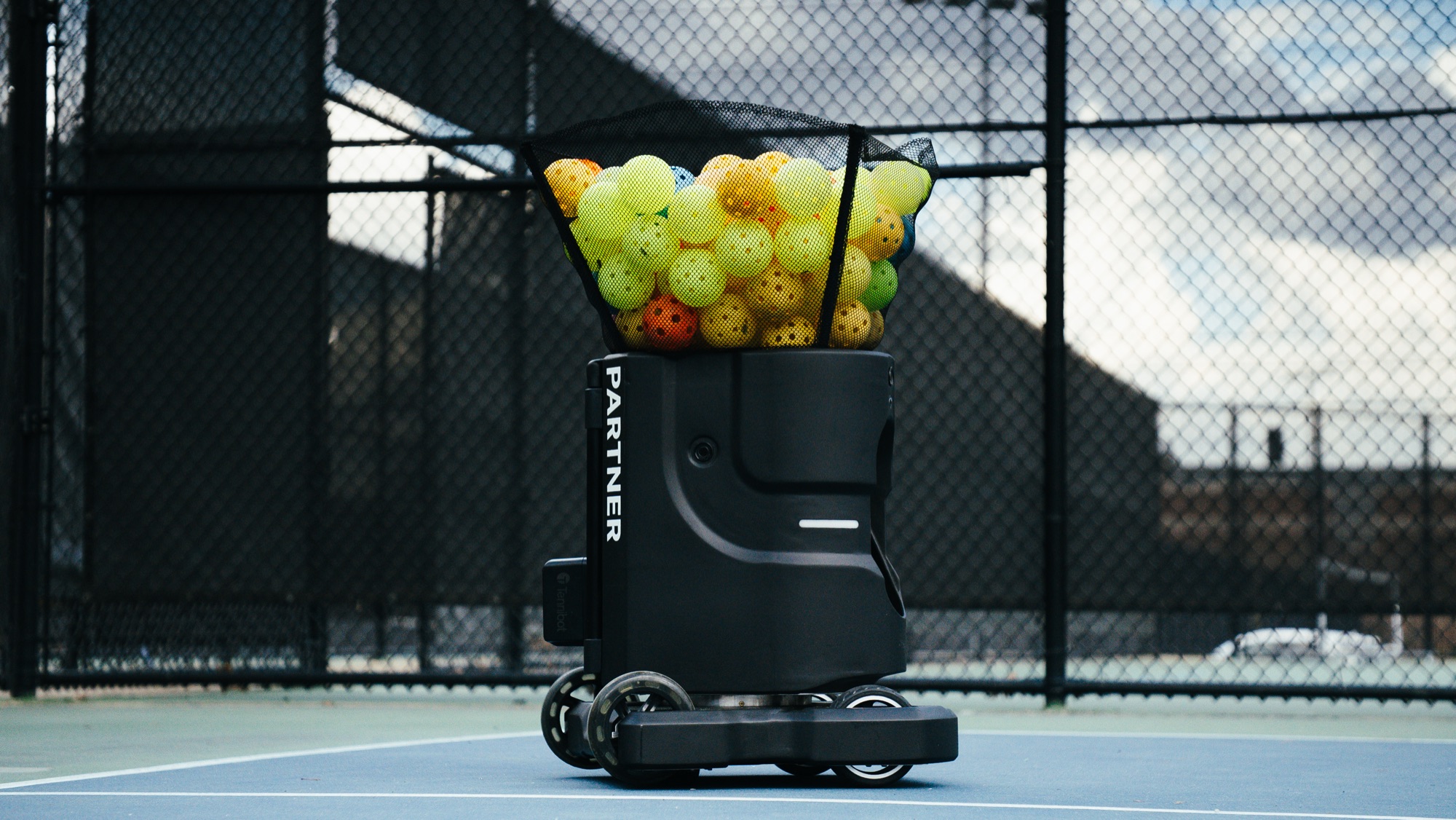
The best pickleball machine in 2026 depends on how you train. After comparing eight machines on price, ball capacity, speed, spin, battery life, and app control, our picks are the Tennibot Partner V2 ($2,275) for the most game-like solo training, the Titan ONE (from $2,299) as the best of the stationary machines, and the Slinger Pickleball ($899) for tight budgets. Prices in this guide run from $899 to about $2,300, and every machine here supports topspin and backspin, but only one of them moves.
Full disclosure: we make one of these machines. Tennibot builds the Partner V2, so read our "best overall" pick with that in mind. To keep this list useful anyway, we did three things: we included every serious competitor, we verified every spec against the manufacturer's own current product pages (July 2026), and we tell you exactly where each machine, including ours, loses. If you want the best machine that fires from a fixed spot, we point you to Titan. If you want the cheapest credible machine, we point you to Slinger. Our machine is not the right pick for everyone, and this guide says so.
Top Picks at a Glance
- Best overall (game-like training) → Tennibot Partner V2 ($2,275), the only machine that moves and tracks you
- Best stationary machine → Titan ONE (from $2,299), Pickleheads' top overall pick
- Best battery + hopper in a stationary machine → Erne ($1,999) with 150 balls and up to 6 hours
- Most portable → Hydrogen Electron ($1,695), a real 65 mph machine at just 18 lbs
- Best under $1,400 without an app → Lobster Pickle Two ($1,349 on sale)
- Best budget → Slinger Pickleball ($899), with real trade-offs you should know about
Comparison Table: Every Machine We Evaluated
| Machine | Price (Jul 2026) | Capacity | Top speed | Spin | Battery | Weight | Control | Warranty |
|---|---|---|---|---|---|---|---|---|
| Tennibot Partner V2 | $2,275 | 250 balls | 65 mph | Top/back, 3,600 RPM | 4–5 hrs | 35.4 lbs | App + Apple Watch | 3 years |
| Titan ONE | from $2,299* | 85 (exp. 240) | 70 mph | Top/back | 2–3 hrs | 48 lbs | Titan Drills app | 2 years |
| Erne | $1,999 | 150 | 65 mph | Top/back | 3–6 hrs | ~50 lbs | App (BLE) | 2 years |
| Hydrogen Electron | $1,695 | 80 | 65+ mph | Top/back, 2,000 RPM | 1,000+ shots | 18 lbs | Tap-to-aim app | 1 year |
| Lobster Pickle Two | $1,349 (sale) | 125 | 60 mph | Top/back | 4–6 hrs | 42 lbs | Remote (no app) | 2 years |
| Pickleball Tutor Plus | $1,319 | 110 | 65 mph | Top/back | 2–4 hrs | 34 lbs | Knobs; remote opt. | 3 years |
| Slinger Pickleball | $899 | 92 | 45 mph | Top/under | up to 3 hrs | 42 lbs | Remote | 1 year |
*Titan ONE base price excludes the battery; a 6AH battery + charger configuration adds to the sticker. Titan runs frequent $250-off promo codes. Prices verified against manufacturer pages July 2026 and updated quarterly.
1. Tennibot Partner V2: Best Overall for Game-Like Training
Our pick, and our product
$2,275 · tennibot.com · 60-day money-back, 3-year warranty, made in USA
The Partner V2 is the machine we build, so here is the case for it in plain numbers, followed by the honest case against it.
The Tennibot Partner V2 holds 250 pickleballs, the largest standard hopper of any machine on this list, and is the only pickleball machine that physically moves along the baseline while using its 4K cameras to track where you are standing. Every other machine here fires from a fixed spot, which is exactly why practice against a static machine starts feeling like a metronome. The Partner varies position, pace (10–65 mph in pickleball mode), and spin (up to 3,600 RPM of topspin or backspin) based on your position, runs 4–5 hours on a charge, recharges in about 90 minutes, and weighs 35.4 lbs. Its app builds fully custom drills like any machine in the app-controlled tier, with one dimension nobody else has: shots can be programmed from any position on the court to land anywhere on the court, because the machine itself moves. It's controlled from iOS/Android and, uniquely in this category, an Apple Watch.
Independent reviewers have reached similar conclusions. Pickleheads calls the Partner "the first pickleball machine that moves across the court like a real player" and "the closest to training with a human," and The Pickleball Gang's February 2026 review concluded that for an obsessed player, an instructor, or "someone determined to drill your way to a 5.0 rating, the Tennibot is worth every penny."
Pros
- Only machine with autonomous movement + AI player tracking: training feels like a rally, not a drill
- 250-ball hopper and 4–5 hr battery: the longest uninterrupted sessions of any machine tested
- Strongest coverage in the category: 3-year warranty, 60-day trial
Cons
- Premium price, and overkill if you just want repetitive feeds to a single spot
- 65 mph pickleball top speed trails the Titan ONE's 70 mph
- No AC power option, so all-day club use means switching batteries between sessions
Get it if: you train alone often and want match-like variety, or you're a coach running long sessions. Skip it if: you mainly drill one shot to one spot; a $1,300 machine does that fine.
2. Titan ONE: Best Stationary Machine
Best stationary machine
From $2,299 (battery sold separately; ~$2,199 at retailers) · titanballmachines.com · 2-year warranty
Pickleheads named the Titan ONE its best overall pickleball machine for 2026, and among machines that fire from a fixed spot, it's the one to beat. The Titan Drills app is polished (12 presets, unlimited custom drills, MegaDrill chaining, and QR-code drill sharing between players), and its internal "stealth" oscillation means the shell doesn't telegraph where the next ball is going. It covers 10–70 mph from dinks to lobs, and swappable external batteries plus an AC option make it a strong fit for all-day club duty. The difference from our pick is architectural: every Titan drill plays out from one fixed position on the court, while the Partner programs drills that also move.
Pros
- Polished drill app with MegaDrill chaining and QR-code drill sharing
- Stealth internal oscillation masks shot direction
- Swappable external batteries + AC option suit all-day coaching
Cons
- 2–2.5 hours of real-world battery under heavy use, the weakest on this list
- 85-ball hopper is small without the extension; 48–56 lbs to lift into a trunk
- Recurring "Alarm 5" ball-jam reports with dirty or soft balls; base price excludes the battery
Get it if: you want the best fixed-position machine with proven all-day power options. Skip it if: you want long unattended sessions or something you can carry with one hand. See our full Tennibot vs. Titan ONE comparison.
3. Erne: Best Battery and Hopper in a Stationary Machine
Best stationary endurance
$1,999 (frequent $250-off promos) · ernepickleballmachine.com · 2-year warranty
The Erne holds 150 pickleballs and runs 3–6 hours per charge, the best endurance of any stationary machine here. Its internal yoke oscillation hides shot direction the way Titan's does, its app offers 28 court positions and per-shot customization in Pro Mode, and the company has a genuine track record of shipping software updates that fix user complaints. It's the strongest pure value in the app-controlled tier.
Pros
- 150-ball hopper and class-best stationary battery life
- Clean, frequently-updated app; stealth oscillation
- Usually $300+ cheaper than Titan ONE once batteries are counted
Cons
- Reviewers report placement drifting 1–2 ft off the programmed spot
- ~50 lbs and bulky; it won't fit some sedan trunks
- 30-day returns carry up to a 25% restocking fee; internal battery can't be hot-swapped
Get it if: you want app control and long sessions at the lowest price. Skip it if: pinpoint placement accuracy or easy transport is your priority. See our full Tennibot vs. Erne comparison.
4. Hydrogen Electron: Most Portable
Most portable
$1,695 · hydrogensports.com · 1-year warranty · listed sold out as of July 2026
Designed by the engineer behind the Apple Pencil, the 18-lb Electron is by far the lightest full-power machine here, less than half the weight of anything else on this list, yet it still delivers 65+ mph and 2,000 RPM of spin. Its "Tap-to-Aim" app is the most intuitive control scheme we've seen: tap a spot on a court diagram and the machine aims there. The catch: an 80-ball hopper, a 1-year warranty, and as of July 2026 it's sold out with no restock date.
Pros
- 18 lbs: carry it in one hand with real 65+ mph power
- Tap-to-aim app is the easiest drill setup in the category
- Quick-swap 18V batteries, 1,000+ shots per charge
Cons
- 80-ball hopper is the smallest on this list
- 1-year warranty (a paid second year) vs 2–3 years elsewhere
- Supply-constrained: sold out as of July 2026, US-48 shipping only
Get it if: you haul your machine to public courts and weight matters most. Skip it if: you want long feeding sessions; you'll be refilling every few minutes.
5. Lobster Pickle Two: Best Under $1,400 Without an App
Best no-app value
$1,349 on sale (reg. $1,749) · lobstersports.com · 2-year warranty · made in USA
Not everyone wants an app between them and their practice. The Pickle Two is the best of the old school: 125 balls, 10–60 mph, topspin and backspin, random and 2-line oscillation, and a 4–6 hour battery, all controlled from a physical 10-function remote. Lobster machines are fixtures at clubs across the country for a reason. Note that Lobster's inventory has been spotty in mid-2026: three of its four pickleball models showed backordered when we checked.
Pros
- Oscillation and spin control included at base price, while competitors charge extra
- 4–6 hour battery; proven, club-trusted platform
- Big wheels handle gravel and rough paths well
Cons
- No custom drills on any Lobster model; wifi remote add-on is Apple-only
- 60 mph ceiling is the lowest of the full-size machines here
- Mid-2026 availability is unreliable, with most models backordered
Get it if: you want set-and-drill simplicity with real oscillation. Skip it if: you'll eventually want programmable sequences; there's no upgrade path.
6. Pickleball Tutor Plus: Simplest Club Workhorse
Simplest to run
$1,319 base (options add up: 2-line oscillation $200, remote $200) · sportstutorcompany.com · 3-year warranty · made in USA
Sports Tutor has been building ball machines for decades, and the Tutor Plus is the machine instructors reach for when they want knobs, not menus: 110 balls, 10–65 mph, topspin/backspin, and a 3-year warranty that only Tennibot matches in this group. The trade-off is a machine that's low-tech for its price once you add options, and the remote can't be retrofitted later, so spec it right at purchase.
Pros
- Dead-simple knob controls; nothing to pair, update, or troubleshoot
- 3-year warranty and a long durability track record with clubs
- 5-star average across 85 retailer reviews
Cons
- Options push the real price toward $1,700+ (oscillation, remote, elevation all cost extra)
- Users report inconsistent ball trajectory and finicky elevation adjustment
- No app, no drills, and the remote must be ordered with the machine
Get it if: you're a club or instructor who values simplicity and warranty over features. Skip it if: you want any programmability at all.
7. Slinger Pickleball: Best Budget Pick, With Caveats
Best budget
$899 (Tournament Pack with oscillator, remote, 60 balls) · slingerbag.com · 1-year warranty
At $899 including the oscillator and remote, the Slinger is the cheapest credible pickleball machine you can buy; everything else at this price is a toy. The wheeled duffle-bag design is genuinely portable and the battery holds up through 2+ hour sessions. Know what you're buying, though: a 45 mph top speed that advanced players will outgrow, a 1-year warranty, some user reports of control-board failures, and a brand whose parent company was sold off in late 2024, which puts a question mark over long-term parts support.
Pros
- $899 all-in: oscillator and remote included, no upcharges
- Roll-anywhere duffle design, fastest setup of the group
- Battery comfortably covers 2+ hour sessions
Cons
- 45 mph ceiling; can't simulate drives or bangers
- Reliability complaints (control boards, jams) and just a 1-year warranty
- Brand changed hands in a 2024 fire sale; long-term support is uncertain
Get it if: you're a beginner-to-intermediate player testing whether machine training sticks. Skip it if: you drill against hard drives; you'll hit its ceiling within a season.
Also Worth Knowing About
Titan ACE ($2,199): Titan ONE's platform in a lighter, modular 39-lb body with a 110-ball hopper; backordered at time of writing. Pickleball Tutor Spin ($1,119): the Tutor with left/right sidespin instead of topspin/backspin; the only sidespin machine in the group. Simon 2 ($1,675): a club-grade workhorse with a 160-ball hopper and a 5-year warranty, but no built-in oscillation or spin control. Lobster Pickle Champion ($1,799 on sale): adds six preset pro drills and full random oscillation. Volley: an impressive AI gameplay simulator, but lease-only for clubs (roughly $1,500–3,000/month), not consumer-purchasable. PongBot Aura ($499–$999) and Tenniix Pickle Pro ($1,299): crowdfunded 2026 entrants with eye-catching spec sheets that haven't shipped production hardware or accumulated independent reviews; we'll evaluate them when they do.
How We Evaluated These Machines
We build ball machines, which means we obsess over everyone else's. For this guide we verified every specification against each manufacturer's current product pages in July 2026 (not cached spec sheets; several prices and models changed this year), cross-checked real-world battery life and reliability against independent reviews from Pickleheads, The Pickleball Gang, and retailer review sections, and drew on our own court time: we have played with every machine on this list to get familiar with how each behaves beyond its spec sheet. Where a manufacturer's claim couldn't be independently verified, we say so. We flagged every machine's availability problems, including when they were sold out and we weren't.
What Actually Matters When Choosing (60-Second Buying Guide)
Ball capacity sets your rhythm: 100+ balls is roughly 5–6 minutes of continuous feeding; the Partner V2's 250-ball hopper runs 12–15 minutes per cycle. Real battery life matters more than claimed: stationary machines claiming 3 hours often deliver 2 under heavy oscillation. Weight decides whether the machine actually leaves your garage: under 20 lbs is one-handed, 35 lbs is manageable, 50+ lbs is a two-person lift into an SUV. Spin at 2,000–3,000 RPM is what makes drilling against dips and slices realistic. And app control vs remote is a philosophy question: apps unlock custom drills but add a failure mode; remotes just work. For a deeper walkthrough of all six factors, see our guide on how to choose a pickleball machine. For the tennis side of the market, see our guide to the best tennis ball machines in 2026.
Frequently Asked Questions
What is the best pickleball machine in 2026?
For overall training realism, the Tennibot Partner V2 ($2,275), the only machine that moves along the baseline and tracks the player with AI. Among stationary machines, the Titan ONE. For budgets under $1,000, the Slinger Pickleball. (Disclosure: Tennibot publishes this guide and makes the Partner V2.)
How much does a pickleball machine cost?
Credible machines run $899 (Slinger) to about $2,300 (Titan ONE, configured) in 2026. The app-controlled tier clusters at $1,999–$2,299, and budget machines under $800 generally aren't worth buying. Watch for options: some "base prices" exclude the battery or oscillation.
What is the best portable pickleball machine?
At 18 lbs the Hydrogen Electron is the lightest full-power machine, though it has no AI and no player tracking, and its hopper holds 80 balls. If you want the AI drills and the app in something you can carry in one hand, the 25-lb Tennibot Partner Lite ($1,495) is the lightest machine with AI tracking and still holds 250 pickleballs; the 35.4-lb Partner V2 adds court movement on top of it.
Is a pickleball machine worth it?
If you play twice a week or more and can't always find drilling partners, yes: a machine delivers hundreds of repetitions per hour on exactly the shot you're fixing. Match the machine to your level: a 45 mph budget machine suits beginners, while 4.0+ players need 60+ mph and real spin.
How many balls should a pickleball machine hold?
100 or more for meaningful solo practice; that's about 5–6 minutes of continuous feeding. Hoppers on 2026 machines range from 80 balls (Hydrogen Electron) to 250 (Tennibot Partner V2).
Sources
- Manufacturer product pages, fetched July 2026: tennibot.com, titanballmachines.com, ernepickleballmachine.com, hydrogensports.com, lobstersports.com, sportstutorcompany.com, slingerbag.com
- Pickleheads: Best Pickleball Machines (updated Oct 2025) and individual Titan ONE / Erne / Titan ACE reviews
- The Pickleball Gang: Tennibot Partner review (Feb 2026), Titan review (Jan 2026), Erne review (Apr 2026)
- The Dink: Hydrogen Sports / Electron profile; The Robot Report: Partner V2 launch (Apr 2026)
- Retailer review sections at Pickleball Central; Trustpilot (Slinger); SGB Media / SEC filings (Slinger ownership change)
Last updated July 3, 2026. We re-verify prices and availability quarterly and note substantive changes here.