
How to Choose a Tennis Ball Machine (2026 Buyer's Guide)
Six factors decide whether a tennis ball machine becomes your best training partner or an expensive garage decoration. Here's how six of the most popular machines stack up, ours and our competitors' alike.
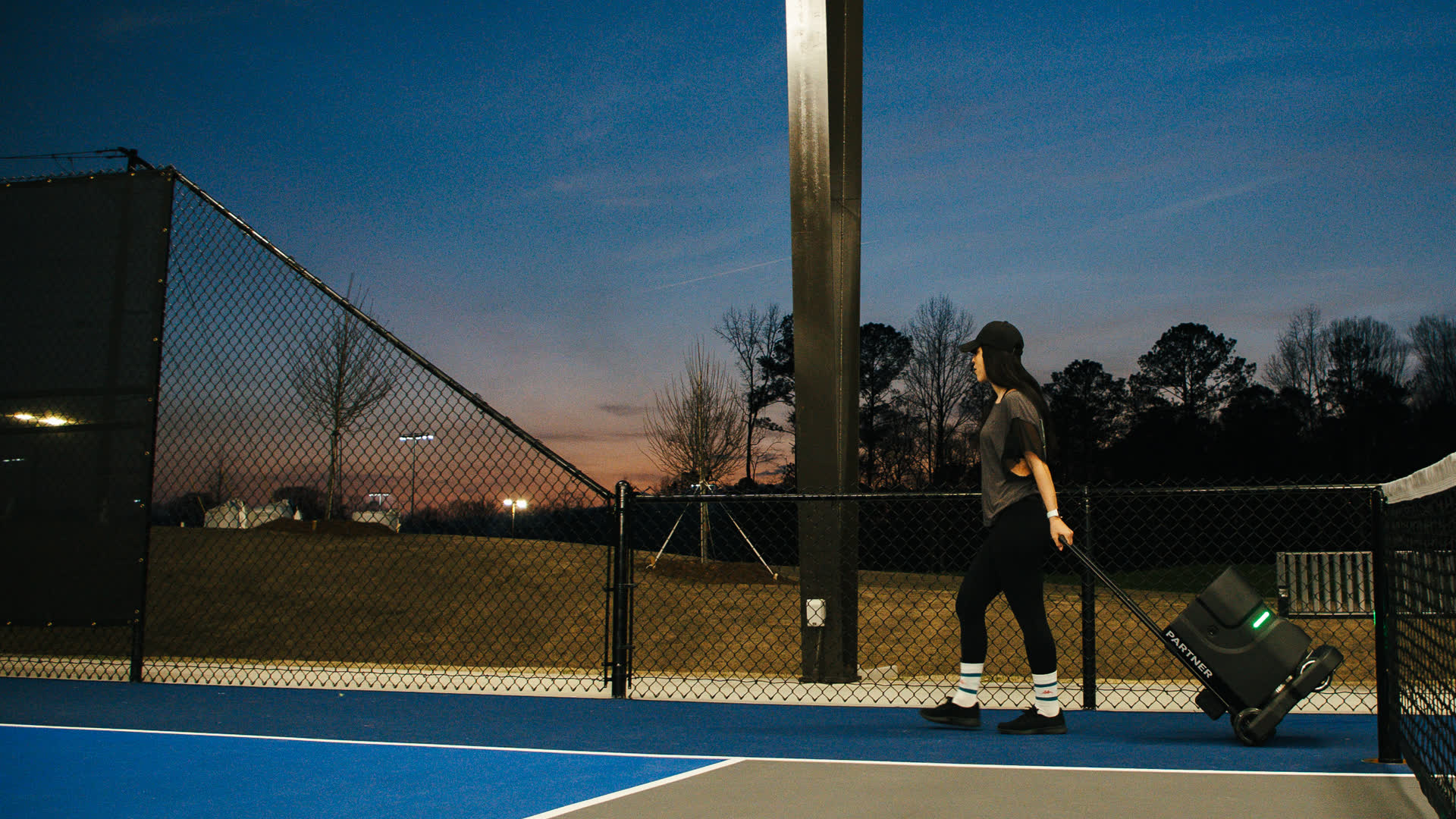
A tennis ball machine is the fastest way to rack up reps without waiting on a hitting partner's schedule, but the wrong one becomes an expensive garage decoration. The right choice comes down to six factors: ball capacity, speed and spin, court mobility and how closely it simulates a real opponent, control style, battery life, and the warranty behind it.
This guide walks through each factor with real specs from six of the most popular tennis ball machines on the market in 2026, including ours and our competitors', so you can decide what actually matters for your game.
Best-in-category figures across every machine in this guide, not all from one machine. See the comparison table below for who leads where.
What Does a Tennis Ball Machine Do?
A tennis ball machine automatically feeds balls at adjustable speeds, spins, trajectories, and intervals so you can drill without a partner. Entry-level machines toss a predictable ball to one spot with a mechanical oscillator sweeping side to side. Advanced machines add app-programmed drill sequences, and, at the top end, use AI cameras to track your position and move around the court like a real opponent instead of firing from a fixed spot.
The 6 Factors That Matter
1. Ball capacity: how long you rally before you pick up balls
Capacity determines how long you hit before practice turns into ball collection. Most full-size machines hold 100–150 balls:
| Machine | Ball capacity |
|---|---|
| Hydrogen Proton | 100 |
| Tennibot Partner V2 | 140 |
| Slinger Bag | 144 |
| Spinfire Pro 2 | 150 |
| Lobster Elite Two | 150 |
| Tennis Tutor Plus | 150 |
At one ball every four seconds, a 100-ball hopper lasts about 6 minutes 40 seconds, while 150 balls lasts about 10 minutes. Capacity is a real factor, but it isn't the whole story: our own Partner V2 holds slightly less than the 150-ball leaders because it also carries the drive motors, cameras, and compute that let it move around the court. That's a real tradeoff, not a defect: fewer balls in the hopper in exchange for a machine that can actually move around the court.
2. Speed and spin: can it push you?
Speed and spin needs depend on your level. Beginners should prioritize low-speed consistency, simple controls, placement, and an adjustable feed rate. Intermediate players will usually find that 60–70 MPH with adjustable spin provides plenty of room to progress. Advanced players may benefit more from 70+ MPH and stronger spin control when recreating higher-pressure balls.
Machines in this category range from 45 MPH (Slinger Bag, fixed topspin only) up to 85 MPH (Tennis Tutor Plus). Don't judge a machine by top speed alone. Placement, spin consistency, trajectory, and drill variety usually matter more.
Leave yourself some room to improve. A machine you can outgrow quickly may cost more in the long run than buying enough capability upfront.
3. Court mobility: does it move like a real opponent?
This is the factor that separates a ball machine from an actual training partner, and it's where the gap between machines is widest. Almost every machine oscillates: it sweeps shots left and right across the baseline from a fixed position. Some, like the Spinfire Pro 2, do this with a silent internal mechanism so you can't read where the next ball is going by watching the body move. That trains lateral coverage, but every ball still originates from the same spot on the court, which is nothing like playing a human opponent who moves, resets, and hits from wherever they end up.
Among the mainstream machines compared in this guide, the Tennibot Partner V2 is the only one that physically moves around the court between shots. It uses onboard cameras to track your position and feed balls from different spots on the court, the way an actual opponent would. The Spinfire, Lobster, Hydrogen, Tennis Tutor, and Slinger models compared here fire from a fixed position.
This is the single biggest gap between machines in this guide. Each can vary speed and spin, but the Partner V2 also varies where the ball comes from. If you mostly drill mechanics, a stationary machine is fine, and usually cheaper. If you want practice that actually feels like a match, movement is the feature that changes everything.
4. Control style: knobs, remotes, or an app
There are three control philosophies, and the right one depends on you:
Knobs and dials (Tennis Tutor Plus): nothing to pair, nothing to update. Coaches running long lesson blocks often prefer this simplicity, though a remote is a $200 add-on and there's no app or custom drills at any price. Remote control (Lobster Elite Two and Spinfire Pro 2, both of which include one): a useful middle ground, though the Lobster Elite line sticks to straightforward oscillation rather than programmable drills. Full app control (Hydrogen Proton's tap-to-aim, Tennibot Partner V2): build, save, and adjust custom drills from your phone, with the newest machines layering AI on top, tracking ball flight and player position in 3D and, in the Partner V2's case, controllable from an Apple Watch mid-rally.
5. Battery life and charge time: the spec everyone forgets
A long session is 2–3 hours, so claimed battery life matters less than how it holds up. Standard lead-acid batteries (Spinfire's base configuration) can lose capacity over time: one long-term owner measured roughly 2 hours by year two, and the lithium upgrade costs an extra $299. Manufacturers report runtime in different ways, and some do not publish recharge time. Among the figures available, the Tennibot Partner V2 recharges in about 90 minutes, while the Tennis Tutor Plus's standard charger takes about 12 hours unless you pay for the fast-charge option.
Weight matters too if you're hauling the machine from car to court: tennis machines range from 17 lbs (Hydrogen Proton) through 33–42 lbs (Slinger Bag, Tennibot Partner V2, Lobster Elite Two, Tennis Tutor Plus) up to 40–53 lbs (Spinfire Pro 2).
6. Warranty, returns, and who's behind the machine
A tennis ball machine is a motorized device that lives outdoors and eats balls all day. Things wear. Before you buy, check:
Warranty length: industry standard is 1–2 years; 3 years (Tennibot Partner V2 and Tennis Tutor Plus) is the longest currently offered. Watch for carve-outs: Lobster's battery is warrantied only 6 months, and Titan-style machines often exclude the battery from the headline term. Return policy: some brands charge restocking fees, Spinfire's is 10% plus a $120 fee if the machine was used on clay. A 60-day money-back trial with free returns means you can actually test the machine on your own court risk-free. Company track record: both the Slinger Bag and Hydrogen Proton were sold out as of August 2026. Slinger has also received some recent customer complaints involving replacement-part availability and support delays, which is worth considering for long-term ownership. Availability and support responsiveness are worth weighing alongside the spec sheet, since they determine how quickly you're back on the court if something goes wrong.
Tennis Ball Machine Comparison (2026)
How we compared these machines: Specifications and pricing were verified against manufacturer websites in August 2026. Prices and availability may change. Where manufacturers report battery performance differently, we preserve their published measurement rather than converting estimates.
| Machine | Price* | Capacity | Top speed | Control | Battery runtime | Recharge time | Moves on court | Warranty |
|---|---|---|---|---|---|---|---|---|
| Slinger Bag | $749 | 144 | 45 MPH | Basic remote | 3.5 hrs | Not stated | No | 1 yr |
| Hydrogen Proton | $1,695 | 100 | 70 MPH | Tap-to-aim app | 1,000+ shots | Not stated | No | 1 yr |
| Lobster Elite Two | from $1,599 | 150 | 80 MPH | Remote included | 4–8 hrs | Not stated | No | 2 yr |
| Tennis Tutor Plus | $1,729 | 150 | 85 MPH | Knobs (remote +$200) | 4–6 hrs | ~12 hrs | No | 3 yr |
| Spinfire Pro 2 | $2,499* | 150 | 80 MPH | Remote + app incl. | 3–8 hrs | 4–6 hrs | No | 2 yr |
| Tennibot Partner V2 | $2,275 | 140 | 70 MPH | App + Apple Watch | 4–5 hrs | ~90 min | Yes, autonomous | 3 yr |
*Prices as of July/August 2026; check each manufacturer for current pricing. Spinfire price is the manufacturer's published figure; US street pricing may vary.
Every machine here earns its place for someone. The Slinger Bag is the cheapest way to find out whether machine training sticks. The Hydrogen Proton is the one you can actually carry in one hand. The Lobster Elite Two is the proven, mainstream workhorse. The Tennis Tutor Plus is the coach's knob-controlled favorite with the fastest top speed. The Spinfire Pro 2 is the best machine in this comparison that fires from a fixed spot. The Partner V2 is the pick if you want AI-tracked drills and a machine that moves like an opponent. For our full ranked breakdown with pros and cons on each machine, see the best tennis ball machines in 2026.
Which Tennis Ball Machine Is Right for You?
Your skill level changes which features deserve the most weight:
- Beginner → prioritize low-speed consistency, simple controls, price, and an adjustable feed rate.
- Intermediate → prioritize spin control, programmable placement, portability, and drill variety.
- Advanced → prioritize realistic pace, strong spin, multi-shot drills, and movement.
- Coach or club → prioritize capacity, durability, battery uptime, warranty, and multi-player usability.
With those priorities in mind, these machines stand out for specific use cases:
- Casual player, tight budget → Slinger Bag. The cheapest real launcher, with real caveats: 45 MPH ceiling, fixed topspin only, and some recent customer complaints about parts and support delays.
- Hauling to public courts often → Hydrogen Proton. Real 70 MPH power at 17 lbs, though the 100-ball hopper means more frequent reloads and it was sold out as of August 2026.
- Best value, no need for programmability → Lobster Elite Two. 150 balls, 10–80 MPH, and a 4–8 hour battery at a mainstream price.
- Serious player who wants match simulation → Tennibot Partner V2. AI player tracking, autonomous full-court movement, and the fastest recharge in the category.
- Club or facility → prioritize capacity, battery, and warranty over price; downtime costs more than the machine.
Ready to see the difference AI makes? The Tennibot Partner V2 comes with a 60-day risk-free trial, free shipping, and a 3-year warranty. Try it on your own court, or see how it stacks up against any machine on this list on our comparison pages.
Frequently Asked Questions
How much does a tennis ball machine cost?
Budget launchers start around $749. Mid-range remote and app-controlled machines run $1,600–$2,000. Premium AI and top stationary machines run $2,200–$2,500. Club-grade machines range from $3,899 up to $7,795.
How many balls should a tennis ball machine hold?
For meaningful solo practice, 100+ is a practical minimum. At one ball every four seconds, 100 balls lasts about 6 minutes 40 seconds. The largest hopper among the machines compared here holds 150 balls (Spinfire Pro 2, Lobster Elite Two, Tennis Tutor Plus). The Tennibot Partner V2 holds 140 and is the only machine in this guide that moves around the court while it feeds.
Are tennis ball machines good for beginners?
Yes, and arguably best for beginners, because consistent, repeatable feeds build stroke mechanics faster than unpredictable rally play. Pick a machine with a low speed floor, such as the Lobster Elite Two or Tennibot Partner V2, both of which feed from 10 MPH, and add speed and spin as you improve.
What is an AI tennis ball machine?
An AI tennis ball machine uses onboard cameras and machine learning to do things preset machines can't: track the ball and player in 3D, generate custom drills from a plain-language request, and adapt feeds to your position. Among the mainstream machines compared in this guide, the Tennibot Partner V2 is the only one that also moves autonomously around the court between shots.
Can a tennis ball machine replace a hitting partner?
For controlled repetition and consistency, a ball machine has advantages over a hitting partner: it can repeat the same feed hundreds of times without fatigue. For reading an opponent and point construction, you still need live play. Most players improve fastest combining both: machine drills for mechanics, live matches for tactics.