
The Best Tennis Ball Machines in 2026: Honest Comparison From a Company That Makes One
Six machines compared on price, capacity, speed, spin, battery life, and control. We make one of them, and we tell you exactly where each machine wins and loses, ours included.
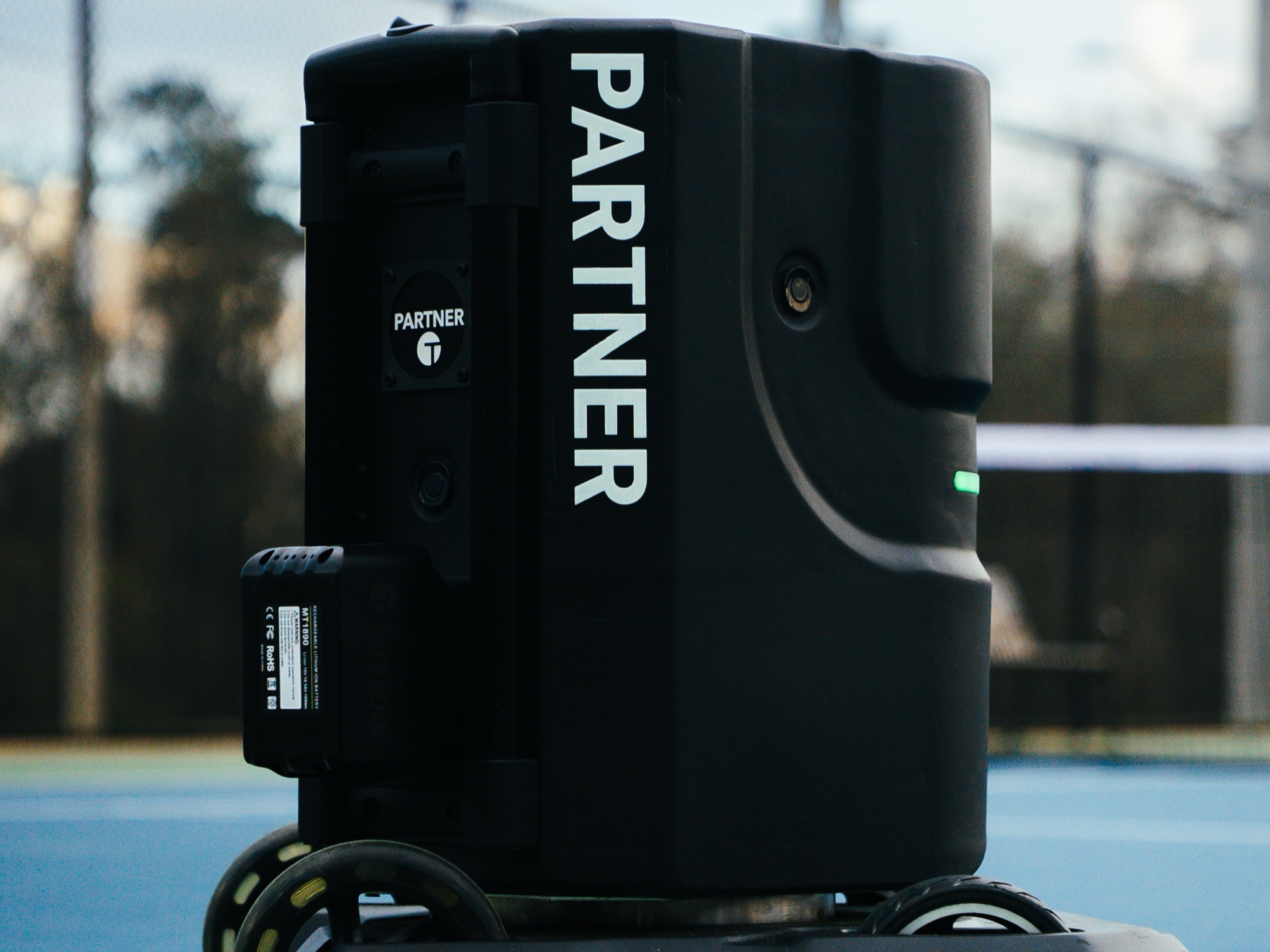
The best tennis ball machine in 2026 depends on how you train. After comparing the market's leading machines on price, ball capacity, speed, spin, battery life, and control, our picks are the Tennibot Partner V2 ($2,275) for the most game-like solo training, the Spinfire Pro 2 ($2,499) as the best of the stationary machines, and the Lobster Elite Two (from $1,599) as the best value. Credible machines run $749 to about $2,500, every full-size machine here reaches at least 70 mph, and only one of them moves along the baseline while it feeds you balls.
Full disclosure: we make one of these machines. Tennibot builds the Partner V2, so read our "best overall" pick with that in mind. To keep this list useful anyway, we did three things: we included every serious competitor, we verified every spec against the manufacturer's own current product pages (July 2026), and we tell you exactly where each machine, including ours, loses. If you want the best machine that fires from a fixed spot, we point you to Spinfire. If you want the most machine per dollar, we point you to Lobster. Our machine is not the right pick for everyone, and this guide says so.
Top Picks at a Glance
- Best overall (game-like training) → Tennibot Partner V2 ($2,275), the only machine that moves along the baseline while feeding structured drills
- Best stationary machine → Spinfire Pro 2 ($2,499), The Tennis Tribe's top overall pick
- Best value → Lobster Elite Two (from $1,599), 150 balls, 80 mph, and a 4–8 hour battery
- Most portable → Hydrogen Proton ($1,695), a real 70 mph machine at 17 lbs
- Simplest club workhorse → Tennis Tutor Plus ($1,729), 85 mph and a 3-year warranty
- Best budget → Slinger Bag ($749), with serious caveats
Comparison Table: Every Machine We Evaluated
| Machine | Price (Jul 2026) | Capacity | Top speed | Spin | Battery | Weight | Control | Warranty |
|---|---|---|---|---|---|---|---|---|
| Tennibot Partner V2 | $2,275 | 140 balls | 70 mph | Top/back, 3,600 RPM | 4–5 hrs | 35.4 lbs | App + Apple Watch | 3 years |
| Spinfire Pro 2 | $2,499* | 150 | 80 mph | Top/slice | 3–8 hrs | 40–53 lbs | Remote + app incl. | 2 years |
| Lobster Elite Two | from $1,599 (sale) | 150 | 80 mph | Top/back | 4–8 hrs | 42 lbs | Remote (~$299 extra) | 2 years |
| Hydrogen Proton | $1,695 | 100 | 70 mph | Top/back, 3,000 RPM | 1,000+ shots | 17 lbs | Tap-to-aim app | 1 year |
| Tennis Tutor Plus | $1,729 | 150 | 85 mph | Top/back | 4–6 hrs | ~46 lbs | Knobs; remote $200 | 3 years |
| Slinger Bag | $749 | 144 | 45 mph | Fixed topspin | 3.5 hrs | 33 lbs | Basic remote | 1 year |
*Spinfire price is the manufacturer's published figure; US street pricing may vary. Prices verified against manufacturer pages July 2026 and updated quarterly.
1. Tennibot Partner V2: Best Overall for Game-Like Training
Our pick, and our product
$2,275 · tennibot.com · 60-day money-back, 3-year warranty, made in USA
The Partner V2 is the machine we build, so here is the case for it in plain numbers, followed by the honest case against it.
The Tennibot Partner V2 is the only tennis ball machine that moves along the baseline while feeding structured drills, using its 4K cameras to track where you are standing and adjust every shot to your position. Traditional machines fire from a fixed spot, which is exactly why practice against them starts feeling like a metronome. The Partner varies position, pace (10–70 mph), and spin (up to 3,600 RPM of topspin or backspin), holds 140 balls, runs 4–5 hours on a charge, recharges in about 90 minutes, and weighs 35.4 lbs. Its app builds fully custom drills like any machine in the app-controlled tier, with one dimension nobody else has: shots can be programmed from any position on the court to land anywhere on the court, because the machine itself moves. It's controlled from iOS/Android and an Apple Watch.
Independent rankings back this up: BallMachineReviews made the Partner V2 its 2026 Editor's Choice for tennis at 9.4/10, and the American Racket Sports Association names it Best Overall Smart/AI machine in its tennis guide.
Pros
- Only machine that moves along the baseline while feeding drills, with AI player tracking: training feels like a rally, not a drill
- 90-minute recharge and 4–5 hr battery: practice twice a day where overnight-charging rivals can't
- Strongest coverage in the category: 3-year warranty, 60-day trial
Cons
- Premium price, and overkill if you just want repetitive feeds to a single spot
- 70 mph top speed trails the Spinfire Pro 2 (80 mph) and Tennis Tutor Plus (85 mph)
- 140-ball hopper is mid-pack; Spinfire, Lobster, and Sports Tutor all hold 150
Get it if: you train alone often and want match-like variety, or you're a coach running long sessions. Skip it if: you mainly drill one shot to one spot; a $1,600 machine does that fine.
2. Spinfire Pro 2: Best Stationary Machine
Best stationary machine
$2,499 · spinfiresport.com · 2-year warranty (5-year +$199)
The Tennis Tribe names the Spinfire Pro 2 its best overall tennis ball machine, and among machines that fire from a fixed spot, it's the one to beat. Its whisper-quiet internal oscillation means the body never rotates, so you can't read where the next ball is going. It throws 20–80 mph with topspin and slice, holds 150 balls, and, unusually for this class, includes both the physical remote and the app at the sticker price; Lobster charges roughly $299 extra for a remote. The app builds custom drills shot by shot. The difference from our pick is architectural: every Spinfire drill plays out from one fixed position on the court, while the Partner programs drills that also move.
Pros
- Silent internal oscillation genuinely masks shot direction
- Remote and app included; polished shot-by-shot drill builder
- 150-ball hopper and up to 8 hours on the lithium battery option
Cons
- Standard lead-acid battery degrades fast (one long-term owner measured ~2 hrs by year two); the lithium upgrade costs +$299
- Most expensive machine on this list, $400+ above Lobster street prices
- Returns carry 10% restocking plus a $120 fee if used on clay
Get it if: you want the best fixed-position machine and hate hearing the oscillator telegraph shots. Skip it if: you want the battery story solved at the base price.
3. Lobster Elite Two: Best Value
Best value
From $1,599 on sale (reg. $1,799) · lobstersports.com · 2-year warranty · made in USA
Lobster's Elite Two is the best value in tennis ball machines in 2026, and the machine you'll see on more public courts than any other: 150 balls, 10–80 mph (the 10 mph floor makes it genuinely beginner- and kid-friendly), topspin and backspin, random horizontal plus vertical oscillation, and a 4–8 hour battery, in a 42-lb body with big all-terrain wheels. It's the best of the old school. Know the fine print: the remote costs about $299 extra, there are no drills at all on the Elite series (Lobster's programmable Grand series starts around $2K), and the included slow charger can cook the battery if you leave it plugged in past full.
Pros
- Proven platform with a huge speed range (10–80 mph) and 4–8 hr battery
- Random horizontal + vertical oscillation at a mainstream price
- Big wheels roll well on gravel and rough paths
Cons
- Remote is ~$299 extra; no drills or programmability on any Elite model
- Battery is only warrantied 6 months, and the standard 12–15 hr charger can damage it if left connected
- Whole-body oscillation telegraphs where the ball is going
Get it if: you want dependable set-and-drill simplicity with real oscillation. Skip it if: you'll ever want programmed sequences; there's no upgrade path within the Elite line.
4. Hydrogen Proton: Most Portable
Most portable
$1,695 · hydrogensports.com · 1-year warranty · listed sold out as of July 2026
Designed by the engineer behind the Apple Pencil, the 17-lb Proton is less than half the weight of anything comparable, yet it still delivers 70 mph and 3,000 RPM of topspin or backspin. Its Tap-to-Aim app is the most intuitive control scheme in the category, and BallMachineReviews rates it an 8.6/10 Editor's Choice. The catch: a 100-ball hopper that needs reloading every 15–20 minutes, a 1-year warranty, and as of July 2026 it's sold out with US-48-only shipping when available.
Pros
- 17 lbs: carry it in one hand with real 70 mph power
- Tap-to-aim app, programmable drills, Apple Watch support
- Quick-swap 18V batteries, 1,000+ shots per charge
Cons
- 100-ball hopper is the smallest full-size capacity here
- 1-year warranty (a paid second year) vs 2–3 years elsewhere
- Sold out as of July 2026; reviewers note fussy first-time calibration
Get it if: you haul your machine to public courts and weight matters most. Skip it if: you want long uninterrupted feeding sessions.
5. Tennis Tutor Plus: Simplest Club Workhorse
Simplest to run
$1,729 (remote +$200) · sportstutor.com · 3-year warranty · made in USA
Sports Tutor has been building ball machines for over 30 years, and the Tennis Tutor Plus is the one instructors reach for when they want knobs, not menus: 150 balls, up to 85 mph (the fastest on this list), dial-controlled topspin and backspin, random plus 2-line oscillation, a 4–6 hour battery, and a 3-year warranty that only Tennibot matches in this group. The Plus Player variant ($2,039) adds a preset mode that imitates beginner-to-advanced opponents. The trade-off is a machine that's low-tech for its price once you add options, and the standard charger takes about 12 hours.
Pros
- Dead-simple knob controls and a 30-year durability reputation
- 85 mph top speed and a 150-ball hopper
- 3-year warranty, US-based factory service
Cons
- Every remote is a paid add-on; no app, no custom drills
- 12-hour standard charge (fast charger costs extra)
- Users report the oscillator is hard to re-center, causing uneven side-to-side spread
Get it if: you're a club or instructor who values simplicity and warranty over features. Skip it if: you want any programmability at all.
6. Slinger Bag: Best Budget Pick, With Serious Caveats
Best budget
$749 (oscillator extra) · slingerbag.com · 1-year warranty · listed sold out as of July 2026
At $749 the Slinger is the cheapest real tennis launcher, and the wheeled duffle-bag design is genuinely clever: it rolls like luggage, holds your racquets, and even charges your phone. Beyond that, expectations should be modest. It tops out at 45 mph with fixed topspin only, and Elouan Tennis's hands-on scored it 2.3/5, calling the spin "completely unrealistic" in quantity.
Pros
- Cheapest real launcher; rolls like a travel bag at 33 lbs
- 144-ball capacity and 3.5 hr battery are solid for the price
- Heavy topspin is useful practice against loopy, high balls
Cons
- 45 mph ceiling and fixed topspin only; advanced players will outgrow it fast
- Oscillation costs extra; balls habitually stick on the hopper lip
- Sold out as of July 2026; documented parts and support delays after the 2024 ownership change
Get it if: you're a casual player testing whether machine training sticks, on a hard budget. Skip it if: you hit with pace or want realistic spin variety.
Also Worth Knowing About
Spinshot Player ($2,179): the programmability king of the stationary tier, with 12 fully editable 6-shot drills in a free app, but a 2–3 hr battery with overnight charging. Lobster Elite Three ($1,799): the Elite Two plus 2-line oscillation. Lobster Grand Five ($2,249): adds 12 preset + 6 custom drills. Lobster Phenom ($3,899): 250 balls, AC-only, 99 lbs; a club machine. Playmate iGenie ($7,795): the teaching-club standard, dealer-sold. Sports Tutor Tennis Tower (from $1,795): 225 balls, AC-only club value. Volley: an impressive AI trainer, but club-lease only at roughly $1,500–$3,000/month.
How We Evaluated These Machines
We build ball machines, which means we obsess over everyone else's. For this guide we verified every specification against each manufacturer's current product pages in July 2026 (not cached spec sheets; several prices and models changed this year), cross-checked real-world battery life and reliability against independent hands-on reviews from TennisCompanion, The Tennis Tribe, Elouan Tennis, and BallMachineReviews, and drew on our own court time: we have played with every machine on this list to get familiar with how each behaves beyond its spec sheet. Where a manufacturer's claim couldn't be independently verified (like Spinfire's US pricing), we say so. We flagged every machine's availability problems, including when they were sold out.
What Actually Matters When Choosing (60-Second Buying Guide)
Ball capacity sets your rhythm: at a 4-second feed, 150 balls is about 10 minutes of continuous hitting; 100 means reloading every 6–7 minutes. Real battery life matters more than claimed: lead-acid batteries in this category routinely degrade to half their rated runtime within two seasons, and several machines need overnight charging, which caps you at one session a day. Weight decides whether the machine actually leaves your garage: 18 lbs is one-handed, 35 lbs is manageable, 49+ lbs wants a court with storage. Spin at 2,000–3,000 RPM is what makes drilling against heavy topspin and slices realistic; machines with fixed or single-direction spin get unrealistic fast. And control style is a philosophy question: apps unlock custom drills, physical remotes just work, and at Lobster and Sports Tutor the remote costs $200–$300 extra. For a deeper walkthrough of all six factors, see our guide on how to choose a tennis ball machine. For the pickleball side of the market, see our guide to the best pickleball machines in 2026.
Frequently Asked Questions
What is the best tennis ball machine in 2026?
For overall training realism, the Tennibot Partner V2 ($2,275), the only machine that moves along the baseline while feeding drills and tracking the player with AI. Among stationary machines, the Spinfire Pro 2. For value, the Lobster Elite Two. (Disclosure: Tennibot publishes this guide and makes the Partner V2.)
What is the best AI tennis ball machine?
The Tennibot Partner V2 is the most mature AI tennis ball machine in 2026: it combines 4K camera player tracking with autonomous baseline movement while feeding drills, and it is backed by a 3-year warranty. First-generation rally robots have started shipping, but early hands-on reviews report erratic movement, short battery life, and 1-year warranties.
What is the best portable tennis ball machine?
At 17 lbs the Hydrogen Proton is the lightest full-power machine, though it has no AI and no player tracking. The 33-lb Slinger Bag is the lightest budget option. If you want the AI drills and the app in something you can carry in one hand, the 25-lb Tennibot Partner Lite ($1,525) is the lightest machine with AI tracking; the 35.4-lb Partner V2 adds court movement on top of it.
How much does a tennis ball machine cost?
Credible machines run $749 (Slinger) to about $2,500 (Spinfire Pro 2) in 2026. The smart/app tier clusters at $2,199–$2,499, and club machines run $3,899 (Lobster Phenom) to $7,795 (Playmate iGenie). Watch for extras: remotes add $200–$300 at Lobster and Sports Tutor, and battery upgrades add $100–$300.
Is a tennis ball machine good for beginners?
Yes, arguably best for beginners, because consistent repeatable feeds build stroke mechanics faster than unpredictable rally play. Pick a machine with a low speed floor: the Lobster Elite Two and Tennibot Partner V2 both feed from 10 mph, while some premium machines (Lobster Phenom) can't go below 35 mph.
Sources
- Manufacturer product pages, fetched July 2026: tennibot.com, spinfiresport.com, hydrogensports.com, lobstersports.com, sportstutor.com, slingerbag.com, playmatetennis.com, spinshotsports.com
- TennisCompanion: Spinfire Pro 2 and Lobster Elite 2 long-term owner reviews; The Tennis Tribe: Best Tennis Ball Machines (Spinfire #1)
- Elouan Tennis: 16-machine hands-on comparison (Slinger 2.3/5)
- BallMachineReviews: 2026 tennis guide (Partner V2 Editor's Choice 9.4/10, Proton 8.6/10); American Racket Sports Association tennis guide
- SEC filings / SGB Media (Slinger ownership change); Trustpilot (Slinger support reports)
Last updated July 24, 2026. We re-verify prices and availability quarterly and note substantive changes here.